Friday, October 9, 2009

Hell's fury - avoidable

Joseph Jaffe launches into a fairly amusing rant today (Hell hath no fury like someone who's credit card hath been declined). Once you get through the apoplectic part, Joe makes a razor sharp observation about the damage caused when the ads run by American Express conflict with the way the company treats its customers in real life.


Interestingly, Mr. Jaffe is not bent out of shape so much over having his credit limit halved but how the brand did and did not communicate in this time of transition. Amex could have done a few inexpensive things (like reach out with preemptive text or phone call warning that he was reaching his limit) that might possibly have made Joe a more loyal customer. But now he's mad as hell and going for the jugular on this. Let's keep an eye on how many people visit his site, see this video and read his tweet.

In today's transparent marketplace (where everyone has access to YouTube), the way a brand treats its customers is a more powerful driver of brand awareness, affinity and most importantly trust than any ad. Do you think the Amex marketing people should invite themselves to the next operations meeting?
7QCYY79J9KUF

Monday, September 28, 2009

GoodGuide gets it.

The good people at GoodGuide are providing a fantastic service to consumers. They are also changing CPG marketing.

GoodGuide has created "the world's largest and most reliable source of information on the health, environmental, and social impacts of the products in your home.
" What's in it? Who makes it? Where and how? What is the environmental impact of this product across its entire life cycle? These are some of the questions GoodGuide seeks to answer. They rate products to make it easy to quickly make better purchase decisions.

Over a million people have visited website (still in beta) and already there are over 70,000 products rated.

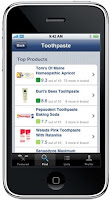
Over 100,000 people have downloaded the free GoodGuide iPhone app making it easy to take this knowledge to the store shelf. A bar code reading capability is due out shortly.

GoodGuide is candid about building a platform for "normal people" (not just bleeding edge, environmentally conscious, health freaks) to make healthier, socially and environmentally conscious decisions everyday.

It's somewhat ironic that people must seek out resources like GoodGuide to get the information they want on the products they buy. The extraordinary lengths GoodGuide has had to go to sleuth-out this information is equally ironic.

One of the founders, Dara O'Rourke in an interview today on Minnesota Public Radio shared anecdotes about how some companies were maneuvering to keep information pertaining to ingredients and environmental impact out of public view. Other more enlightened brands are actively working with GoodGuide to improve their scores.

Eventually brands will realize that transparency is a powerful differentiator and path to growth. First movers will likely reap disproportionate benefits. GoodGuide is dramatically accelerating this process. What's your product's GoodGuide score?

Friday, September 25, 2009

Hyatt exposed

Hyatt Hotels has been getting a lot of press the last few days for firing housekeeping staff after instructing them to train "vacation replacements" that turned out to be lower cost contract workers who would soon take their jobs. Thanks to Sara Peterson @ Megaphone for pointing me to this HBR Editor's Blog post by Paul Michelmanon assessing the damage.

What are the odds that Hyatt's marketing leadership was aware of the plan to sweep out the housekeeping staff in this fashion? In our transparent marketplace, the marketing department needs to do more than make the ads and brochures. They must be engaged in operational decisions that directly impact the brand. The ramifications from these "simple economic decisions" are often more impactful than any ad or brochure. Today "marketing" is more about brand behavior than glossy images. Wake up Hyatt.

Thursday, September 24, 2009

Beyond the sound bite


An ambitious if somewhat wonky experiment is taking place. Is it possible for two opposing parties to calmly and rationally debate an issue using in-depth, fact based arguments? Can anyone actually be persuaded to change their opinion on an issue after witnessing such a debate? Interesting questions given the pundit-charged, polarized nature of our "national conversation."

Intelligence Squared US is bringing the formal, "Oxford style" debate format to key issues facing the U.S. They've been at it for three years now and are starting to get some visibility. IQ2US tackles issues ranging from the demise of mainstream media to the efficacy of "Buy American" policies. The radio broadcast is available on over 190 NPR stations nationwide and is televised on Bloomberg, reaching over 200 million homes. I encourage you to listen to one of these debates. They are informative, surprisingly fun and charged with same kind of drama that kept millions tuned into Perry Mason.

A citizen making a voting decision is analogous to a consumer making purchase decision. Based on available information, both make a choice. Poor decisions generally happen when the information is incomplete or inaccurate. It's an understatement to say the quality of information available to the average citizen or consumer today is less than ideal.

Is there an appetite for more rigorous and in-depth public debate? Viewership of the 2008 presidential debates indicates there is. Are consumers open to more and better fact based information in making purchasing decisions? It appears so when one looks at the popularity of sites like TripAdvisor.com and Yelp.com (where consumers have essentially filled this need on their own).

Bottom line: Politicians and marketers have an opportuity to improve their standing (and outcomes) by taping into this appetite for deeper dialog and better information. Could the pendulum be swinging from the era of superficiality to one of substance?

Tuesday, September 15, 2009

Former ad guys concur


It seems fellow recovering advertising executive, James P. Othmer has a similar perspective regarding the ability of social media to help President Obama persuade the masses. Check out his recent New York Times op-ed piece here.

Friday, August 21, 2009

Social media failing health care debate. Turn on the TV.

It's painful to watch. President Obama makes speech after speech detailing the rational argument for a health care overhaul. His opponents serially attack elements of the proposal creating fear, uncertainty and doubt among much of the population. Those opponents offer few meaningful alternatives for fixing the situation. Liberals are livid that "red meat radio" mis-characterizes the issues and distorts the facts. Conservatives worry that they will be left on the sidelines of a liberal stampede. The cycle repeats.

Social media and the larger blogosphere, key drivers of Obama electoral success, are disappointing in their ability to influence this debate. This should not be surprising. Most of social media vehicles are self-reinforcing in nature - people who share common interests or perspectives talking to one another. The "lunch bucket" voter who might genuinely benefit from a health care overhaul is not hearing how he or she could benefit. The progressive, hell bent on a public option, is not hearing from those who sincerely believe it will ultimately subsume private options. We're effectively at a rhetorical standoff in the digital universe on this issue.

Social media was a potent tool for rallying supporters to elect the president. Surveying my in box, it's clear the Obama Administration is attempting to leverage social media again on this issue. One problem: the health care debate is a very different animal. The Democrats hold the White House and majorities in both branches of congress. The base is rallied. If Obama genuinely wants consensus, he needs those who are not his supporters to actually hear his argument.

This is where good old-fashioned traditional media could be more effective than the cool digital stuff. Imagine a nationally televised debate (or series of debates) where the President spends an hour sparing with a notable Republican (or health care industry leader) on the health care issue. Just the spectacle of a real human-to-human debate might cause us to look up from Huffington or Hannity to see what's going on. Remember that well over 50 million viewers tuned into each of the most recent Presidential debates.

A televised debate could provide the one element sorely missing in the health care conversation: drama. Sominex would be envious of the sedative powers of the President’s most recent New York Times op-ed piece making the case for health care reform – the boilerplate for his recent speeches. What’s needed is the drama of a heated exchange or a “gotcha” moment on national TV.

Most importantly, a debate could raise the level of dialogue from rumors, innuendo and finger pointing to a serious, thoughtful exchange of ideas. A well-viewed debate could provide a common context and language for more productive "water cooler" debates in our offices the next day. That’s the only route I see to any form of consensus. In the end, consensus may not be a realistic goal. Regardless of which way the health care issue is ultimately resolved, it would be nice for most citizens to at least be accurately informed.

Setting politics aside, social media excels at building enthusiasm among the like minded. It sucks at enabling dialogue between disparate perspectives.

Thursday, August 20, 2009

Whole Foods' values train wreck

There's a lot of clamor today regarding Whole Foods CEO John Mackey's recent op-ed in the Wall Street Journal where he came out against many of the ideas contained in the Obama administration health care overhaul initiative.

Right or wrong, Mackey's POV conflicts with the leanings of many Whole Foods patrons who reportedly tend to support the Obama approach. Quite the social media furor is underway. Over 20,000 Facebook members have pledged to boycott the chain. The debate has prompted a new forum on the Whole Food website with over 14,000 posts.


The image of the original hippy store used to illustrate the "values" page on the Whole Foods site paints an image that does not line-up with the viewpoint of the CEO. Shopping at Whole Foods (and paying the significant premiums involved) is an overt values statement for most customers.

In this transparent era it would seem that either Whole Foods needs to migrate to a less progressive values position or the CEO needs to recant or even possibly resign. The current "values dissonance" will only erode the Whole Foods brand and franchise.

What would you do if you were on the Whole Foods board of directors?